Palladium-Catalyzed Radical Reactions via Pd(I) Pathway: A Brief Summary of Reaction Patterns and Recent Progress (Invited Review).
经历Pd(I)途径的钯催化自由基反应:模式简述和近期进展(中文综述)
Abstract
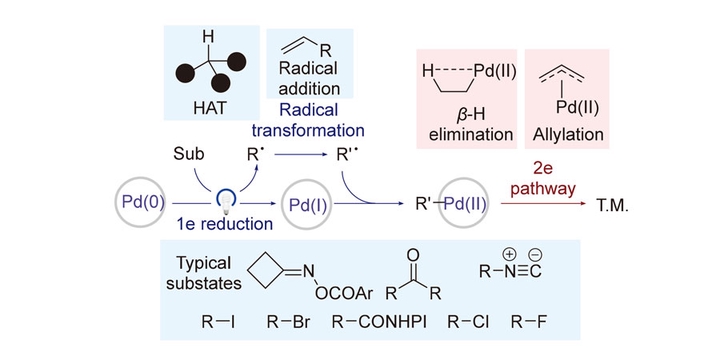
In the toolbox of modern organic synthesis, palladium-catalyzed reactions represent a vital category that has long been considered to follow classical two-electron pathways. However, research over the past two decades, and particularly recent breakthroughs, has demonstrated the existence of a parallel and equally significant field: palladium-catalyzed reactions involving single-electron transfer (SET), halogen atom transfer (XAT), and radical mechanisms. This new reaction paradigm not only expands the catalytic capability of palladium, enabling the activation of traditionally inert chemical bonds, but also offers the potential to achieve novel chemoselectivity, regioselectivity, and stereoselectivity. This review aims to organize this frontier field, focusing primarily on radical pathways that proceed via Pd(I) intermediates. In these reactions, palladium primarily acts as a radical initiator, generating radicals through redox processes of ground-state or excited-state Pd(0), or via the homolysis of Pd(II)–C bonds. The typical palladium oxidation state cycle is Pd(0)-Pd(I)-Pd(II). From the perspective of radical generation methods, this review categorizes radical reaction patterns involving Pd(I) intermediates, summarizes recent progress in the field, and provides commentary on the underlying reaction mechanisms.

Yi-Fan Tan
PhD student, class of 2025